
How Mixed Reality Hardware Enhances Traditional Online Games
Introduction: Bridging Two Gaming Worlds
Traditional online games have long been experienced through flat screens on PCs, consoles, and mobile devices. Players interact with virtual environments using controllers, keyboards, or touchscreens. However, the rise of mixed reality hardware is changing this familiar setup by blending digital elements with the physical world.
Mixed reality (MR) goes beyond virtual reality and augmented reality by allowing real and virtual objects to coexist and interact in real time dewa138 . When applied to traditional online games, this technology enhances immersion, interaction, and engagement in ways that were not possible before.
Understanding Mixed Reality Hardware
Mixed reality hardware includes devices such as advanced headsets, spatial sensors, depth cameras, and smart glasses. These devices are designed to map the physical environment and overlay digital content onto it with high precision.
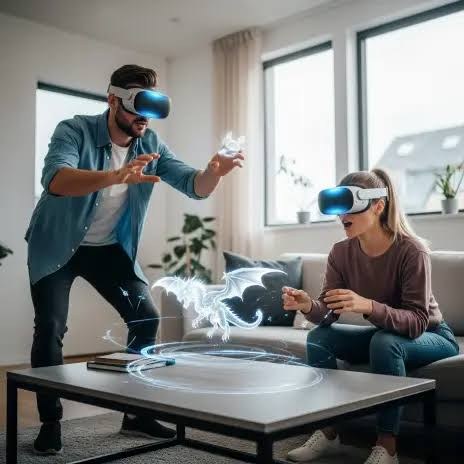
Unlike traditional gaming systems, mixed reality hardware allows players to see game elements integrated into their real surroundings. For example, a game interface might appear on a real table, or virtual characters might move across a living room floor.
This seamless integration of real and digital spaces creates a more interactive and engaging gaming experience.
Transforming Traditional Online Game Interfaces
One of the biggest improvements mixed reality brings to traditional online games is the transformation of user interfaces. Instead of viewing menus, maps, and health bars on a flat screen, players can interact with them in a three-dimensional space.
Game dashboards can float in the air, weapons or tools can be selected through hand gestures, and mission objectives can appear as virtual objects within the environment. This makes gameplay feel more natural and intuitive.
By moving away from flat interfaces, mixed reality enhances player immersion and reduces the separation between the user and the game world.
Enhancing Immersion in Multiplayer Experiences
Multiplayer online games benefit significantly from mixed reality integration. Players can see virtual avatars or representations of teammates positioned within their real environment.
This creates a stronger sense of presence and collaboration. Instead of relying solely on voice chat or on-screen indicators, players can visually interpret spatial positions and movements.
Team-based strategies become more dynamic because communication is supported by both visual and physical cues. This improves coordination and makes multiplayer interactions feel more lifelike.
Improving Spatial Awareness and Gameplay Depth
Mixed reality hardware introduces a new level of spatial awareness to traditional online games. Players can physically move around their space to interact with virtual objects or gain different perspectives.
For example, in strategy games, players might walk around a virtual battlefield displayed on a real table. In action games, they could physically dodge or lean to avoid attacks.
This added physical interaction increases gameplay depth and allows developers to design more complex and engaging mechanics that go beyond traditional screen-based limitations.
Integration With Existing Game Platforms
One of the most important advantages of mixed reality technology is its ability to integrate with existing online game platforms. Developers do not need to completely rebuild games from scratch. Instead, they can enhance current titles with MR features.
For example, a traditional racing game can project a 3D track onto a real surface, or a first-person shooter can display tactical maps and inventory systems in the physical environment.
This compatibility allows game studios to gradually adopt mixed reality features without disrupting existing player bases.
Social Interaction in Shared Physical Spaces
Mixed reality also improves the social aspect of online gaming. Players in the same physical space can see and interact with shared virtual elements together, even while playing online with others.
This creates hybrid social environments where real-world and online interactions blend seamlessly. Friends can gather in a room and experience the same virtual game environment together, making gaming more collaborative and social.
It also enhances streaming and content creation, as viewers can see both the physical and digital aspects of gameplay in a more engaging format.
Enhancing Game Design and Creativity
Game developers benefit greatly from mixed reality hardware because it opens new possibilities for creative design. Instead of being limited to screens, developers can design interactive environments that extend into real-world spaces.
Puzzle games, for example, can require players to physically move objects or solve spatial challenges in their environment. Adventure games can place clues or characters in different areas of a room, encouraging exploration.
This level of creativity allows for more innovative gameplay experiences that were previously impossible with traditional online gaming systems.
Impact on Player Engagement and Retention
Mixed reality enhances player engagement by making games more immersive and physically interactive. When players are actively moving and interacting with their environment, they become more emotionally and mentally invested in the experience.
This increased engagement leads to longer play sessions and higher retention rates. Players are more likely to return to games that offer unique, real-world interaction rather than purely screen-based experiences.
The novelty and depth of mixed reality also attract new audiences who may not have been interested in traditional gaming formats.
Challenges in Mixed Reality Gaming Adoption
Despite its potential, mixed reality gaming still faces several challenges. Hardware cost is one of the biggest barriers, as advanced MR devices can be expensive for average consumers.
Another challenge is space requirement. Many mixed reality experiences require a clear physical area for movement, which may not be available in all homes.
Technical limitations such as battery life, processing power, and motion tracking accuracy also need continuous improvement to ensure smooth gameplay experiences.
The Future of Mixed Reality in Online Games
The future of mixed reality in traditional online games is highly promising. As hardware becomes more affordable and compact, adoption is expected to increase significantly.
Advancements in artificial intelligence, cloud computing, and spatial mapping will further enhance the realism and responsiveness of mixed reality systems. Games will become more adaptive, interactive, and personalized based on player behavior and environment.
Eventually, mixed reality may become a standard layer in online gaming, transforming how players interact with digital content in everyday life.
Conclusion: A New Dimension for Traditional Gaming
Mixed reality hardware is redefining traditional online games by merging physical and digital experiences. It enhances immersion, improves gameplay interaction, and creates new opportunities for social and creative engagement.
As technology continues to evolve, mixed reality will bridge the gap between screen-based gaming and real-world interaction, leading to a future where online games are no longer confined to displays but extend into the spaces we live in.
